
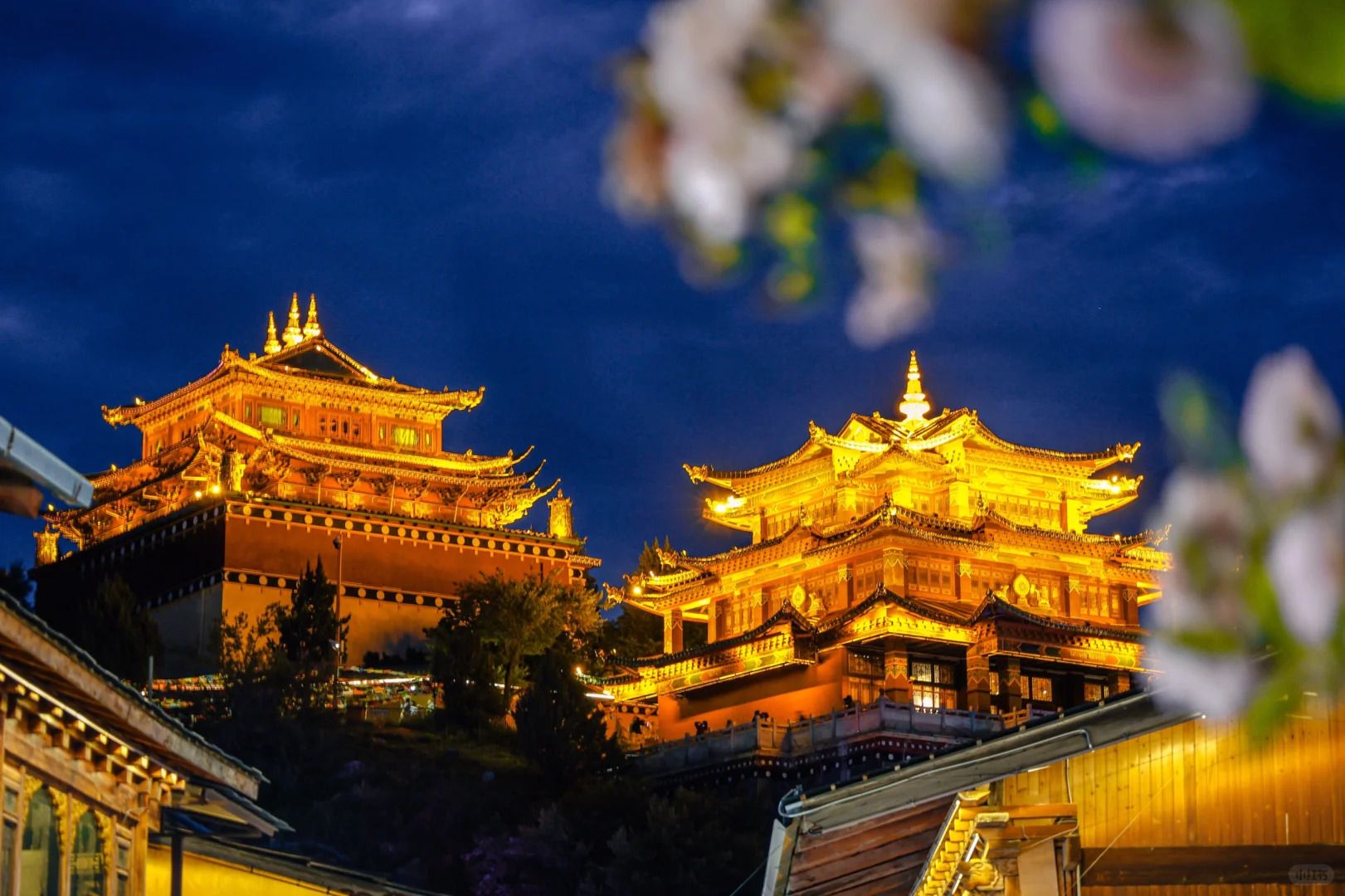
There is a moment, just after you pass through the old stone gate and step onto streets polished smooth by a thousand years of hooves and boots, when Dukezong Ancient Town stops you in your tracks. The air is thin at 3,160 meters. The late afternoon sun turns the carved wooden facades of Tibetan houses a deep amber. Somewhere above you, on the hill, prayer flags snap in the wind. And you realize: this is not a museum. People live here. They have lived here since the Tang Dynasty.
Dukezong — meaning “Moonlight City” in Tibetan, or more literally, “Castle Built on Stone” — is the best-preserved Tibetan old town in Yunnan’s Shangri-La. For over 1,300 years, it sat at a critical crossroads of the Ancient Tea-Horse Road, where caravans from Yunnan’s tea country rested before the brutal climb into Tibet. Today it is a living, breathing neighborhood where Tibetan grandmothers spin prayer wheels in the morning and tourists from six countries join a circle dance after dark.

A Brief History of Dukezong Ancient Town
The story starts in 634 CE. The Tibetan King Songtsen Gampo ordered a fortress built on Daguishan Mountain to control the trade route between Yunnan and Lhasa. That fortress became Dukezong.
The town grew outward from the hilltop in the shape of an eight-petal lotus flower, a layout you can still trace on a map today. For centuries, it was one of the most important stops on the Tea-Horse Road. Yunnan merchants hauled compressed pu’er tea up from the lowlands. Tibetan traders brought horses, wool, and medicinal herbs down from the plateau. The stone streets were worn concave by the hooves of their pack animals — those same stones are still under your feet when you walk through town.
In January 2014, a fire broke out and destroyed roughly a third of the old town. The Chinese government and local Tibetan community rebuilt Dukezong over the following years using traditional construction methods. The town earned its National 4A Tourist Attraction designation in 2023.
The World’s Largest Prayer Wheel on Guishan Hill
If you only do one thing in Dukezong, climb Guishan Hill and turn the giant prayer wheel. The prayer wheel — officially named Jixiang Shengchuang, meaning “Auspicious Victory Banner” — stands over 20 meters tall at the top of Guishan Park. It weighs 16 tons and holds more than one million Buddhist scriptures inside.
Getting to it requires a climb from Moonlight Square — about 15 minutes at 3,160 meters of altitude. Take it slow. When you reach the top, it takes three or four people working together to turn it. You grab a handle alongside strangers — Chinese tourists, Tibetan pilgrims, backpackers — and you push. The wheel groans, then begins to rotate. Bells ring with each revolution. According to Tibetan Buddhist tradition, each turn sends the prayers of a million scriptures into the universe.
While you are up there, look for Da Fo Si temple and the Baita white stupa. The views of Dukezong from the hilltop are the best you will get.

Moonlight Square and the Guozhuang Dance
Every evening around 8 PM, something wonderful happens in Moonlight Square. Local Tibetan residents set up a speaker, traditional music starts playing, and a circle dance begins. This is the Guozhuang dance — one of the oldest Tibetan folk traditions — and it happens every single night.
It starts with a few locals. Then tourists get waved in. Within twenty minutes, there might be a hundred people in concentric circles, stepping and swaying to the music. Nobody cares if you have no idea what you are doing. The steps are simple and the person next to you will show you.
This is free. Nobody is selling tickets. It is the nightly social ritual of a Tibetan town that happens to welcome outsiders. Show up at Moonlight Square around 8 PM and wait. Someone will pull you in.

Walking the Ancient Streets of Dukezong
The Stone Streets
The stone-paved streets are original — worn smooth by centuries of tea-horse caravan animals. You can see the grooves where they walked. On a rainy day, the wet stones catch the light and the whole town glows.
Sifang Street and the Old Core
Sifang Street is the heart of the old town — narrow lanes lined with traditional Tibetan wooden buildings, craft shops, restaurants, and tea houses. The buildings are two and three stories tall with carved wooden balconies and painted window frames in red, blue, and gold.
Thangka Workshops and Tibetan Crafts
Several workshops produce Thangka paintings — intricate Tibetan Buddhist scroll paintings made with mineral pigments and gold leaf. Some welcome visitors to watch and offer short introductory classes. You will also find handmade Tibetan silver jewelry, traditional incense, and hand-woven textiles.

Tibetan Food You Must Try in Dukezong
Yak Butter Tea
Salty, not sweet — tea churned with yak butter and salt. Your first sip might surprise you. By your third cup, you will understand why Tibetans drink it all day long: at 3,160 meters, in cold dry air, it hydrates and warms you like nothing else.
Yak Meat Hotpot
Leaner and more flavorful than beef, with a slightly gamey richness. The local way is hotpot-style: a bubbling broth with sliced yak meat, highland vegetables, mushrooms, and noodles. Perfect on a cold Shangri-La evening.
Tsampa, Tibetan Yogurt, and Highland Barley Wine
Tsampa is roasted barley flour — nutty and filling. Tibetan yogurt is thick and tangy, often with honey. Highland barley wine (qingke jiu) is a mild fermented drink. At this altitude, go easy.

Many small restaurants only accept WeChat Pay or Alipay. Carry cash as backup. See our guide to paying in China as a foreign tourist.
Want to Explore Dukezong Without the Hassle?
Shangri-La sits at 3,160 meters and getting around takes planning. Our local team can arrange transport, accommodation, Tibetan-speaking guides, and a flexible itinerary that works at your pace.
Best Time to Visit Dukezong
May to June: The best window. Wildflowers, warm days (15-20°C), cold nights. The sweet spot.
July to August: Warmest but monsoon rains. Beautiful in the rain but crowded.
September to November: Clear skies, autumn colors, excellent. November gets cold fast.
December to February: Harsh cold (minus 10°C at night). Many places close. Skip unless you want a Tibetan winter experience.
For a broader picture, read our best time to visit Yunnan guide.
How to Get There
By Air: Shangri-La Diqing Airport is just 2km from the old town — 20 minutes by taxi. Direct flights from Kunming (~1 hour).
By Train: Lijiang to Shangri-La railway, 1-1.5 hours. From the station, taxi to Dukezong is 15 minutes.
By Bus: From Lijiang (~4 hours) or Kunming (~10 hours). Budget option.
If navigating Chinese transport feels overwhelming, our guide to the language barrier in Yunnan covers what to expect.
Altitude Warning
Dukezong sits at 3,160 meters. Most visitors experience mild symptoms on day one — headache, fatigue, shortness of breath. It usually passes within 24-48 hours.
Acclimatize first — spend a day in Lijiang (2,400m) before heading up. Move slowly on day one. Stay hydrated. Skip alcohol the first night. Do not let this scare you — millions visit every year without problems. Just respect the altitude.
Practical Tips
Entry is free. No ticket needed for the old town.
Dress in layers. Temperature swings of 15°C between midday and evening.
Sunscreen and sunglasses mandatory. UV at 3,160m is intense.
Best time to explore: morning and evening. Midday is crowded with tour groups.
Stargazing from Guishan Hill. Clear nights offer extraordinary stars — high altitude + low light pollution.
Safety: Very safe for foreign tourists. See our Yunnan safety guide.

Ready to Visit Dukezong Ancient Town?
Whether you want a full Shangri-La itinerary or just help with transport and accommodation, our Yunnan-based team can put together a plan that fits your schedule and budget.
FAQ
Is there an entrance fee?
No. Dukezong Ancient Town is free to enter and explore at any time.
How much time do I need?
Half a day to a full day. Climb Guishan Hill, wander the streets, eat Tibetan food, and stay for the evening Guozhuang dance. Overnight visitors can spread this over two days.
Will I get altitude sickness?
Possibly. At 3,160m, mild symptoms are common on day one. Acclimatize in Lijiang first, stay hydrated, avoid alcohol, and take it easy. Usually resolves within 24-48 hours.
Can I stay overnight inside the old town?
Yes — dozens of guesthouses and boutique hotels in converted traditional Tibetan houses. Staying inside lets you experience the evening dance and sunrise from Guishan Hill.
Was Dukezong destroyed by fire?
A 2014 fire destroyed about one-third of the town. It has been carefully rebuilt using traditional Tibetan techniques. The restoration is widely regarded as well done. Dukezong remains a living Tibetan town, very much worth visiting.
