
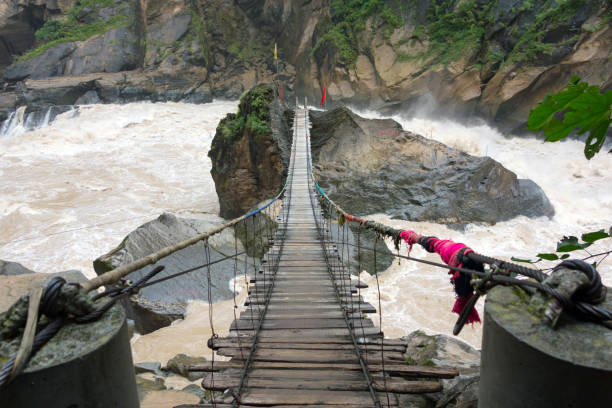
There’s a gorge in Yunnan where the Jinsha River — the upper Yangtze — has carved a canyon so deep it makes the Grand Canyon look like a practice run. Legend says a tiger once leaped across its narrowest point, using a single rock as a stepping stone. That’s Tiger Leaping Gorge (虎跳峡, Hǔ Tiào Xiá), and hiking the High Trail above it is one of the greatest multi-day treks on Earth.
Sitting between Lijiang and Shangri-La, this 17-kilometer gorge drops nearly 3,900 meters from snow-capped peaks to raging whitewater. The High Trail runs along the cliff face high above, giving you two days of jaw-dropping views that have earned it a spot on virtually every “World’s Top 10 Treks” list. And unlike many bucket-list hikes that require weeks of preparation or Sherpa-level fitness, this one is doable for anyone in reasonable shape.
This guide covers everything: the full two-day itinerary, what to expect at the infamous 28 Bends, where to sleep, how to tackle the Middle Gorge if you want more adventure, and all the practical details you need to actually get there and back.

Why Tiger Leaping Gorge Is World-Class
Numbers first: the gorge stretches 17 kilometers, and from the river surface to the summit of Jade Dragon Snow Mountain towering above, the vertical drop reaches 3,900 meters. That makes it one of the deepest river gorges on the planet.
But stats don’t capture what it actually feels like to walk along the High Trail. You’re traversing a narrow path carved into the mountainside, with the Jinsha River thundering far below and all 13 peaks of Jade Dragon Snow Mountain stretched out across the sky in front of you. The air is clean, the scale is absurd, and every bend in the trail reveals something that makes you stop and just stare.
Tiger Leaping Gorge is also part of the UNESCO-listed Three Parallel Rivers region, where the Yangtze, Mekong, and Salween flow within 75 kilometers of each other — a geological marvel you can’t find anywhere else.
The name itself comes from a local Naxi legend: a tiger, chased by a hunter, leaped across the gorge at its narrowest point — just 25 meters wide — using a rock in the middle of the rapids as a stepping stone. That rock is still there in the Middle Gorge, and yes, you can climb down to see it.
The High Trail — Day 1: Qiaotou to Halfway Guesthouse
The High Trail (高路) is the classic trek — roughly 22 to 26 kilometers depending on your exact route, running along the north side of the gorge high above the river. Most hikers do it in two days with one night at the famous Halfway Guesthouse. Here’s how Day 1 breaks down.
Starting Out: Qiaotou to Naxi Family Guesthouse (2 Hours)
The trail starts at Qiaotou (桥头), a small town that serves as the gateway to the gorge. Most hikers arrive by bus from Lijiang (about 2.5 hours) or Shangri-La (about 2 hours). From Qiaotou, you’ll follow signs toward the High Trail — the path climbs gently at first through Naxi villages and farmland, with the gorge opening up below you.
The first two hours are a warm-up. You’ll pass the Naxi Family Guesthouse, a good place to fill your water bottle and catch your breath. The views are already impressive, but they’re nothing compared to what’s coming.
The 28 Bends (2-3 Hours from Naxi Family Guesthouse)
About two hours in, the trail hits the 28 Bends (二十八道拐) — a series of steep switchbacks that zigzag up the mountainside. This is the hardest section of the entire trek, climbing roughly 900 meters in elevation through tight, dusty turns. Your thighs will burn. Your lungs will remind you that you’re above 2,000 meters. It takes most hikers 1 to 2 hours to get through.
But here’s the thing — once you’re past the 28 Bends, the rest of the High Trail is mostly flat or gently rolling. Power through this section and you’ve earned the reward.
If the climb feels too much, local Naxi horsemen wait at the base of the switchbacks with mules and horses. For about ¥200, they’ll carry you to the top. No shame in it — plenty of hikers take the ride and save their energy for Day 2.

Tea Horse Guesthouse to Halfway Guesthouse (2-3 Hours)
After the 28 Bends, you’ll reach the Tea Horse Guesthouse (茶马客栈) around the 3-hour mark from the start. This is a solid rest stop with cold drinks, simple meals, and rooms if you want to split Day 1 into shorter segments (¥150-220/night with good views of the Upper Gorge).
From Tea Horse, the trail follows the mountainside at a comfortable elevation, winding through pine forests and open ridges. Two more hours of walking brings you to the Halfway Guesthouse (中途客栈) — your home for the night. Total walking time for Day 1: roughly 6 to 8 hours depending on your pace and breaks.
Pro tip: Start early. You want to arrive at Halfway Guesthouse before 6pm. Once the sun drops behind the mountains, the trail gets dark fast and there are no lights. A headlamp is essential insurance if you’re running late.
The High Trail — Day 2: Halfway to Tina’s Guesthouse
Day 2 is shorter and — if anything — even more spectacular than Day 1.
The Waterfall Section: The Best 2 Kilometers of the Trek
From Halfway Guesthouse, the trail continues along the cliff face toward the waterfall section (龙洞瀑布). This 2-kilometer stretch is widely considered the most dramatic part of the entire High Trail. Mountain waterfalls cascade across the path, the gorge narrows below, and Jade Dragon Snow Mountain fills the entire horizon. Have your camera out — you’ll use it every 50 meters.

Descent to Tina’s Guesthouse
After the waterfall section, the trail begins to descend toward Tina’s Guesthouse (中峡客栈), which sits near the road at the Middle Gorge entrance. From Halfway, Day 2 takes about 3 to 4 hours of walking.
At Tina’s, you have a choice: catch a bus or taxi back to Lijiang (about 2.5 hours), continue to Shangri-La (about 2 hours), or — if you’re feeling bold — descend into the Middle Gorge for a completely different kind of adventure.
One of the best things about the High Trail is the one-way logistics. You can start on the Lijiang side and end on the Shangri-La side (or vice versa), making it easy to combine with other destinations. Some guesthouses even offer luggage transfer — they’ll drive your big bag from Qiaotou to Tina’s so you only carry a daypack on the trail.
The 28 Bends — Surviving the Hardest Part
Let’s be honest about the 28 Bends: they are tough. The switchbacks climb steeply, the path is dusty and uneven, and if you’re carrying a full pack, you’ll feel every kilo. In the midday sun, it’s hot. In the morning mist, it’s slippery.
But here’s what nobody tells you — the 28 Bends are also where the hike transforms from “nice walk with views” to “this is genuinely one of the great treks in the world.” Every switchback you complete gives you a wider, more dramatic view of the gorge below. By the top, you’re at 2,700 meters looking down at the Jinsha River like it’s a thin silver thread.
Tips for the 28 Bends:
Start before the sun hits the switchbacks — early morning is cooler and less dusty. Take your time; there’s no prize for speed. Drink water constantly. If your knees or lungs say no, grab a horse at the base for ¥200 and ride to the top. The views from horseback are just as good.
Halfway Guesthouse — The Rooftop With the Best View in Yunnan
The Halfway Guesthouse (中途客栈) has become legendary among trekkers, and for good reason. Its rooftop terrace faces directly across the gorge at all 13 peaks of Jade Dragon Snow Mountain. At sunrise, the snow-capped peaks turn gold and pink while the gorge below is still in shadow. It’s one of those views that actually lives up to the photos you’ve seen online.

Rooms run ¥200 to ¥300 per night — incredibly reasonable given that you’re sleeping in one of the most scenic spots in China. The food is simple but filling: noodles, rice dishes, cold beer after a long day on the trail.
Booking tip: During peak season (October and April-May), Halfway fills up fast. Book at least 7 days in advance through WeChat or by calling ahead. If Halfway is full, the Tea Horse Guesthouse (¥150-220/night) two hours earlier on the trail is a solid backup with its own excellent views.
Worried about the language barrier at guesthouses? Most trail accommodation owners speak basic English, but it helps to have a translation app ready. Check our guide to handling the language barrier in Yunnan for practical tips.
Want a Local Guide to Handle the Logistics?
Tiger Leaping Gorge is totally doable on your own — but if you’d rather have someone arrange transport, book the guesthouses, carry your bags, and show you the hidden viewpoints that aren’t on any map, a local guide makes the whole experience smoother. Tell us what you’re looking for and we’ll put together a plan.
Middle Gorge — For the Adventurous
The High Trail is spectacular but relatively safe and well-trodden. The Middle Gorge (中虎跳) is a different beast entirely. This is where you descend from the trail to the river itself — straight down the cliff face.
Three Ways Down
There are three descent routes to the Middle Gorge, each charging about ¥15 for access:
Sky Ladder (天梯) — Vertical metal ladders bolted into the cliff face. This is as intense as it sounds.
Zhang Teacher’s Trail (张老师栈道) — A slightly more forgiving path with chains and fixed ropes.
Yixiantian / Ray of Sunshine (一线天) — A narrow slot where the gorge walls close in to just a sliver of sky above.

At the bottom, you’ll find the Tiger Leaping Stone — the actual rock from the legend, sitting in the middle of the rapids where the gorge narrows to just 25 meters. Standing next to it with the full force of the Jinsha River blasting past is an experience that’s hard to put into words.
Do You Need a Guide for Middle Gorge?
As of 2025, a guide to the Middle Gorge costs roughly ¥600 and may be required depending on conditions. Honestly, even if it’s not mandatory, hiring a guide here is smart. The descent involves vertical ladders, chains, and narrow paths where a wrong step has real consequences.
Best Time to Hike Tiger Leaping Gorge
March to June: Spring is beautiful. Wildflowers bloom along the trail, temperatures are comfortable (15-25°C). April and May are arguably the best months.
September to November: Clear skies, cooler temperatures, golden light. October is peak season — book accommodation early.
July and August: Rainy season. Avoid it. Heavy rains trigger rockfalls, mudslides, and flash flooding.
December to February: Cold, especially at altitude. Some guesthouses close for winter.
For seasonal conditions across the whole province, see our guide to the best time to visit Yunnan.
How to Get There
From Lijiang: Buses to Qiaotou (桥头) daily, about 2.5 hours. Qiaotou is the most common starting point.
From Shangri-La: Buses reach Qiaotou in about 2 hours. You can start from either end.
One-way logistics: Start from Lijiang side, hike 2 days north, catch a bus from the trail’s end to Shangri-La. No backtracking. Some guesthouses offer luggage transfer to the other end.

What to Pack
Hiking shoes with ankle support and grip. Sneakers are not enough.
Rain jacket — weather changes fast in the gorge.
Sunscreen and hat — UV is intense at 2,000+ meters.
2 liters of water — refill at guesthouses, but long stretches with nothing.
Snacks — trail mix, energy bars.
Headlamp — non-negotiable. Zero lighting after dark.
Power bank — patchy phone signal but you’ll want battery for photos.
Cash — guesthouses and horse rentals are cash-based. See our guide to paying in China.
Ticket Prices and Costs
| Item | Cost (CNY) | Notes |
|---|---|---|
| Upper Gorge viewpoint | ¥45 | Drive-up viewpoint only |
| High Trail hiking fee | ¥65 | Separate from viewpoint |
| Middle Gorge descent | ¥15 | Per route |
| Middle Gorge guide | ~¥600 | May be required |
| Horse rental (28 Bends) | ~¥200 | Negotiable |
| Halfway Guesthouse | ¥200-300/night | Book 7 days ahead peak season |
| Tea Horse Guesthouse | ¥150-220/night | Good alternative |
| Bus: Lijiang to Qiaotou | ~¥35-50 | About 2.5 hours |
| Bus: Shangri-La to Qiaotou | ~¥30-45 | About 2 hours |
Budget roughly ¥500-800 total for a 2-day High Trail trek including transport, accommodation, meals, and entrance fees.
Practical Tips
Arrive before dark. Guesthouses expect you by 6pm. The trail has no lighting.
Phone signal is patchy. Download offline maps before you start.
Altitude is manageable. The trail runs between 1,800m and 2,700m — well below altitude sickness threshold for most people.
Rainy season is serious. July-August brings rockfalls, mudslides, and washed-out trail sections. Not just uncomfortable — genuinely dangerous.
Safety overall is excellent. The High Trail is well-established and hiked by thousands yearly. See our guide to safety in Yunnan.

Ready to Hike Tiger Leaping Gorge?
Whether you want a fully guided trek with transport and accommodation sorted, or just need help booking guesthouses and arranging a one-way transfer, we can make it happen. Drop us your dates and preferences.
Frequently Asked Questions
How difficult is the Tiger Leaping Gorge High Trail?
Moderate. No technical climbing. The 28 Bends are strenuous — a steep 1-2 hour climb — but the rest is manageable for anyone with average fitness. Horse option available at the 28 Bends if needed.
Is it safe to hike Tiger Leaping Gorge solo?
Yes. Solo hiking is common and the trail is well-marked and well-trafficked during hiking season. For the Middle Gorge descent, a guide is strongly recommended even for experienced hikers.
Can I hike Tiger Leaping Gorge in one day?
Technically possible if very fit and starting at dawn, but not recommended. The two-day itinerary lets you enjoy the views, and the overnight at Halfway Guesthouse is one of the highlights.
Do I need a guide for Tiger Leaping Gorge?
For the High Trail, no — it’s straightforward and well-marked. For the Middle Gorge, a guide is highly recommended and may be required (~¥600 as of 2025). A guide is also great for logistics: transport, bookings, luggage transfer.
What happens if it rains during my hike?
Light rain outside monsoon season is fine — wear a rain jacket and watch your footing. During July-August, heavy rain creates genuinely dangerous conditions. If heavy rain starts, ask your guesthouse whether it’s safe to continue.
